




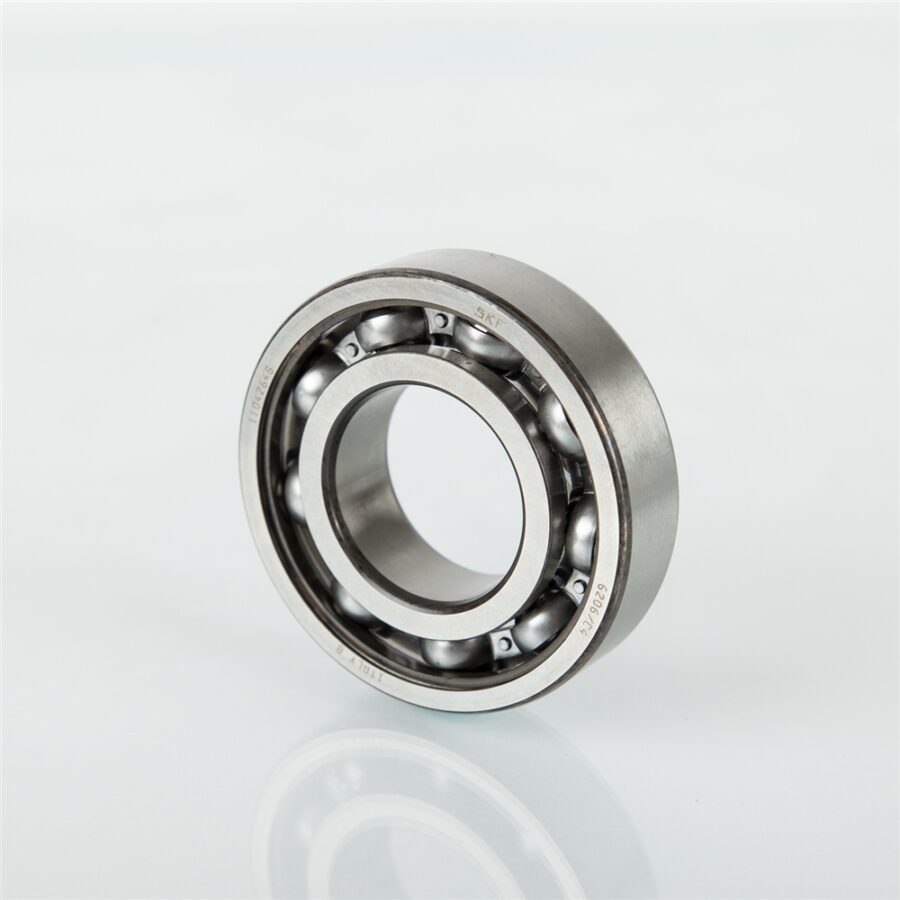
Deep groove ball bearings are some of the most common rolling bearings used in modern machines because they are simple, effective, and long-lasting. A deep, continuous raceway groove holds the balls in place and lets them spin smoothly with little friction at a wide range of speeds. When people talk about a common size like SKF 6409, which is typically seen in maintenance lists and spare parts catalogues for conventional machinery, they regularly come across this type of bearing. The shape of deep groove ball bearings is simple, but their performance depends on careful selection, proper installation, proper lubrication, and sensible working conditions.
The inner ring, the outer ring, the rolling elements (balls), and the cage that spaces the balls evenly are the four basic parts of a deep groove ball bearing. The raceways are “deep” because the groove curvature is very close to the ball radius, which makes it easier to guide and keep the ball stable at high speeds. This is one reason why people often choose a designation like SKF 6409 for applications that need consistent rotation without complicated alignment characteristics. The deep groove shape also lets the bearing handle some axial and radial load, which makes it more practical in real-world machinery.
Engineers choose deep groove ball bearings like the SKF 6409 for a number of reasons, but one of the most important is its load capability. The main design goal is radial load, but the groove shape lets you add a considerable axial component in any direction, especially when the part is installed in a standard way with enough space inside. When the shaft and housing sizes, predicted loads, and desired service life all point to that series and bore, a size like SKF 6409 is commonly chosen. In actuality, the mix of load size, load direction, shock events, and duty cycle is more important than just the headline load rating.
Another strong point is the capacity to go fast. Deep groove ball bearings usually run cooler than other types of bearings under similar conditions because they have low friction torque. That makes a name like SKF 6409 appealing for electric motors, pumps, fans, conveyors, and other rotating equipment where efficiency and stable functioning are important. Speed restrictions still depend on how the parts are lubricated, how the cage is designed, what kind of seal is used, and how heat is released. So, it’s still important to choose the right parts for the job.
The internal clearance has a big effect on how a deep groove ball bearing works when it is put in. Clearance is the small amount of space within that lets things expand as they get hot, fit together tightly, and bend when they are under stress. If the clearance is too tight after mounting, the bearing may get hot, make noise, and wear out faster. If it is too loose, it may vibrate, lose stiffness, and not distribute the load evenly. When a specification has a part number like SKF 6409, it usually also has an internal clearance class to make sure the bearing works in the right temperature and fit conditions.
Sealing and shielding solutions can make a big difference in reliability, especially where there is a possibility of contamination. Open bearings work well in clean places and let you choose how to lubricate them. Shielded or sealed versions, on the other hand, protect against dust and moisture and may hold grease better. You might see a common name like SKF 6409 in both open and sealed versions. Choosing between them is usually a matter of weighing protection, maximum speed, running temperature, and maintenance preference. In tough conditions, sealing can mean the difference between a few months and a few years of useful life.
The material and heat treatment affect how well something can withstand fatigue and how stable its dimensions are. Most deep groove ball bearings are made of through-hardened bearing steel, which is designed to last a long time under rolling contact fatigue and keep its hardness. In some circumstances, different materials or treatments may be used to protect against corrosion or high temperatures. However, these choices change the lubrication demands and may change the load capacity. When consumers ask for SKF 6409 as a reference, they usually want a performance envelope that goes along with a standard bearing steel and a well-known heat-treatment method, not a particular shape.
Once the bearing is chosen, lubrication is the most crucial thing that needs to be done. Grease lubrication is ubiquitous because it’s easy to use, clean, and works well with a wide range of speeds and weights. Oil lubrication can handle higher speeds and temperatures and may be better at getting rid of heat, but it makes the system more complicated. The way a bearing like the SKF 6409 works will change a lot depending on the type of grease, the viscosity of the base oil, the thickener, the fill percentage, and the relubrication intervals. All of these things should be based on the actual duty cycle, not a general plan.
Too much grease is a common cause of overheating and early failure. When there is too much oil in the free space, it churns, which makes heat and drag increase. On the other side, not greasing enough might cause metal-to-metal contact, surface damage, and quick wear. The right amount of grease and when to relubricate should depend on the speed factor, temperature, risk of contamination, and the machine’s stopping and starting profile, whether the bearing is marked SKF 6409 or something similar.
For stable operation, the shaft and housing must fit together correctly. When the ring turns in relation to the load direction, the inner ring usually needs an interference fit to keep it from creeping, which can damage seats and make debris. Depending on the material of the housing, temperature changes, and whether shoulders or coverings are used to hold the axial location, the fit of the outer ring may be tighter or looser. In many maintenance situations, asking for SKF 6409 is just half the story. The seat tolerances, surface finish, and roundness that hold the rings in place are what really matter for service life.
How you align and mount things is also important. Compared to self-aligning varieties, deep groove ball bearings can only handle small amounts of misalignment. This means that the shaft and housing geometry must be rather accurate. When installing, you should never push the balls into the raceways, since this might brinell the raceways and cause them to break early. If the job involves a bearing like the SKF 6409, the safest way to do it is to press on the ring with the interference fit, use controlled heating when needed, and check the axial placement without hammering or putting too much weight on it.
People sometimes don’t realise how important hygiene and handling are. Microscopic contaminants that gets inside the fitting can become stuck and cause dents that make noise and vibration later. Moisture can also damage lubrication and start corrosion, which speeds up wear. Even if a technician is just doing a regular task to repair an SKF 6409 unit, clean workbench, lint-free wipes, closed lubrication containers, and proper storage can all help the unit last longer.
When they are in use, deep groove ball bearings usually fail in one of these ways: fatigue flaking, wear, corrosion, electrical erosion, or damage from bad mounting. After going through a lot of rolling stress cycles, fatigue flaking happens. It can get worse if there is too much weight, not enough lubricating film thickness, or contamination. Wear can happen when there isn’t enough lubrication or the inappropriate viscosity of the lubricant. Corrosion may occur once water gets in or condenses when the machine is not in use. When a part is labelled as SKF 6409, you still need to look at the machine’s surroundings and operating history to find the real cause of the problem.
Vibration and noise might give you vital information. A smooth, consistent noise level that slowly gets louder could mean that the lubrication is getting old or dirty. Sudden shifts, on the other hand, could mean that there is breakage, mounting problems, or the start of flaking. Methods for monitoring the condition of parts, like vibration trending, temperature checks, and lubricant inspection, can find problems early enough to stop shafts and housings from getting damaged again. Setting baseline vibration signatures after installation can assist tell the difference between normal behaviour and early problem development for assets that use SKF 6409 bearings over and over again.
Another useful sign is the temperature. Bearings get hotter when loads go up, speeds go up, lubrication churn goes up, or internal clearance gets too tight because of thermal expansion and fits. Seals can make things hotter by adding friction, and too much grease can make things hotter by churning. If the temperature of an SKF 6409 bearing position rises slowly over weeks, you should check the grease level, fill level, alignment, belt tension, and any changes in how the machine is used.
When choosing a deep groove ball bearing, you need to think about things like the shaft diameter, housing bore, available axial space, load direction, speed, and environment. After the size envelope is defined, the next things to think about are the internal clearance, sealing, cage type, precision class, and lubrication strategy. A lot of people start their search with a well-known reference like SKF 6409 since it gives them the size and series, but a strong specification also lists the application details that stop people from using the wrong one. The “same size” bearing can nonetheless work quite differently depending on how it is set up, even if the machine gets shock loads, starts up often, or gets dirty.
For tough conditions, it is often a good idea to think about design elements that make the machine more reliable without making it more complicated. Better sealing can keep things from getting in; choosing the right grease can make the coating thicker and more resistant to corrosion; and sensible relubrication intervals can keep temperatures stable. If a factory uses SKF 6409 for certain machines, it may also standardise the tools used to install them, the ways they are heated, and the ways they are monitored to cut down on mistakes made by people. The choice of bearing is often less important than how consistently you use it.
Deep groove ball bearings are still popular because they are flexible and behave in a predictable way. They can handle radial and moderate axial loads, work well at fast speeds, and fit into small spaces. But the same simplicity can make people lazy, which can lead to problems like contamination, wrong fits, or bad lubrication that could have been avoided. If you see the term SKF 6409 on a parts list or you are specifying the same size for a new design, you will get the greatest results if you think of the bearing as part of a system that includes seats, lubrication, sealing, and operating conditions.